
Children’s Mental Health Workshop Series
Practical approaches to help Family physicians confidently navigate Child & Youth Mental Health
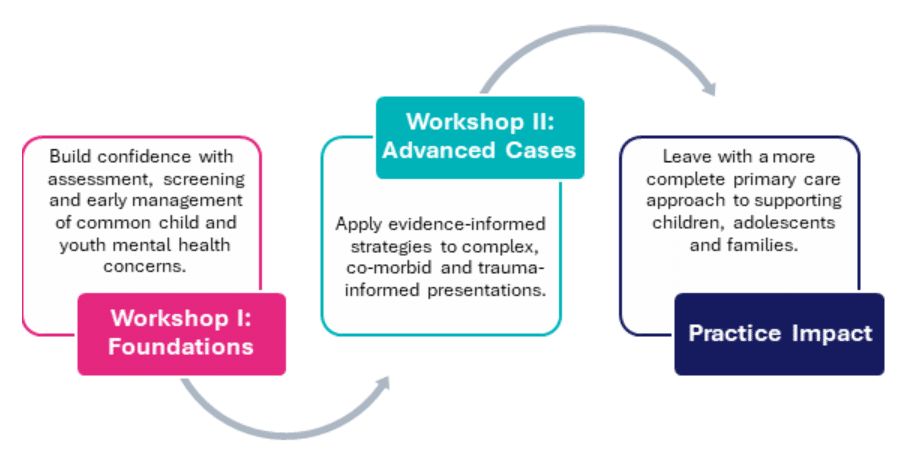
Children and adolescents are increasingly presenting in primary care with mental health concerns that can be difficult to assess and manage in a busy clinical setting. This two-part, case-based workshop series gives family physicians a practical roadmap for recognizing common presentations, using age-appropriate screening tools, initiating evidence-informed treatment, and supporting children, youth and families with confidence.
Designed through a primary care lens, Workshop I builds core assessment and early management skills, while Workshop II applies that foundation to more complex, trauma-informed and co-morbid presentations. Participants are encouraged to attend both workshops to gain a more complete approach to child and youth mental health care — from first presentation to ongoing management

Upcoming Workshop Details
-
Children’s Mental Health in Primary Care: Foundations of Assessment and Early Management – October 7, 2026 (1:30 PM – 4:30 PM)
-
Children’s Mental Health in Primary Care: Advanced Cases and Complex Management – December 2, 2026 (1:30 PM – 4:30 PM)
For the greatest benefit, participants are encouraged to register for both workshops. Workshop I provides foundational assessment and early management strategies; Workshop II builds on that foundation by focusing on complex cases, co-morbid conditions, trauma-informed care and medication considerations.
Why Attend?
-
Strengthen your confidence assessing and managing child and youth mental health concerns in primary care.
-
Learn practical approaches for common presentations such as anxiety, depression, ADHD, grief and adjustment disorder.
-
Apply evidence-based screening tools and clinical resources to support assessment, treatment planning and follow-up.
-
Explore realistic cases that reflect the complexity family physicians see in day-to-day practice.
-
Build a clearer pathway for knowing what to do, what to monitor and when additional supports may be needed.
Who Should Take These Workshops

This series is designed for family physicians, but other healthcare professionals working with children and youth are also welcome. Clinicians who wish to strengthen their capacity to identify, evaluate and manage mental health challenges across developmental stages will benefit from these workshops.
The program blends theory with practical strategies, equipping participants to deliver informed, compassionate and effective mental health care.
Explore Real-World Cases
-
A youth presenting with low mood, functional decline or possible depression.
-
A child experiencing grief, adjustment challenges or family transition.
-
A school-aged child with ADHD symptoms and behavioural manifestations.
-
An adolescent presentation involving trauma, emotional dysregulation or more complex medication management.
-
An adolescent with autism spectrum disorder and overlapping mental health conditions.
Children’s Mental Health in Primary Care: Foundations of Assessment and Early Management
The Foundations workshop focuses on the core principles of mental health assessment in children. Participants will explore how to take a comprehensive psychosocial history specific to school-aged children and adolescents; identify common childhood presentations, including adjustment disorder, anxiety and depression; and review essential concepts related to ADHD. The session emphasizes early identification through use of evidence-based screening tools and introduces pharmacologic and non-pharmacologic management strategies. Attendees will also become familiar with practical tools and clinical resources that support management in primary and community care settings.
Topics include:
- Principles of management for mild to moderate depression and anxiety in primary care
- Screening tools and identification of anxiety and depression in children and youth
- Overview of ADHD, its behavioural manifestations and treatment
- Features and management of grief and adjustment disorder based on developmental stage
- Tools and resources for ongoing support
Learning Objectives
At the conclusion of Module I, participants will be able to:
- Carry out a comprehensive psychosocial mental health history for pediatric patients.
- Describe how children experience grief and/or adjustment disorder based on their developmental stage and apply strategies to support families through these transitions.
- Assess anxiety, depression and ADHD using age-appropriate, evidence-based tools.
- Initiate and monitor pharmacologic management for youth with mild to moderate depression and anxiety.
- Initiate and monitor pharmacologic management for youth with ADHD.
- Screen for suicidal ideation using evidence-based tools and pathways.
- Identify adverse childhood experiences and strategies to mitigate impact.
Children’s Mental Health in Primary Care: Advanced Cases and Complex Management
The Advanced workshop builds on the foundational knowledge from Module I and addresses more complex mood, anxiety, trauma, and neurodevelopmental presentations in adolescents. Core concepts in confidentiality and consent, trauma-informed care, differentiating and managing co-morbid mental health conditions, and pharmacological and non-pharmacological interventions will be covered. Emphasis is placed on integrated, evidence-informed and age-appropriate care. Screening and management strategies will be explored. To be notified once registration opens, email us at ocfpcme@ocfp.on.ca.
Topics include:
- Psychosocial contributors including adverse childhood experiences and trauma
- Differentiating mental health conditions with similar presentations
- Managing co-morbid mental health conditions
- Medication considerations and interaction risks
Learning Objectives
At the conclusion of Module II, participants will be able to:
- Discuss approaches to complex and co-morbid mental health presentations in children and adolescents, such as mood & anxiety disorders, neurodevelopmental disorders, emotional dysregulation and trauma-informed care.
- Recognize potential psychosocial contributors to and interventions for older youth mental health challenges
- Apply developmentally appropriate screening and assessment tools to support early identification and evaluation of adolescent mental health concerns.
- Manage youth mental health conditions using evidence-based and age-appropriate approaches.
- Recognize safe psychopharmacologic principles, including medication interactions and the use of clinical tools and resources to support ongoing care.
What You’ll Take Back to Practice
-
Practical assessment frameworks for common child and youth mental health concerns.
-
Screening tools and clinical resources to support early identification and follow-up.
-
Approaches to treatment planning for anxiety, depression, ADHD, grief and adjustment disorder.
-
Strategies for supporting youth with trauma-informed, complex or co-morbid presentations.
-
Greater confidence navigating conversations with children, adolescents and families.
Not sure which module to sign up for?
Read below to see who each module is best suited for and what you can expect to gain.
Children’s Mental Health in Primary Care: Foundations of Assessment and Early Management
Best for f****amily physicians who are:
-
new to or less familiar with children’s mental health topics
-
early years in practice
-
seeking a structured refresher on core concepts
What you’ll gain:
-
practical frameworks for assessment of common mental health presentations in primary care
-
evidence-based tools
-
strategies to support patients and families
-
collaborative care pathways
-
curated tools you can use in clinic the next day.
Format: Interactive workshop with cases and take‑home resources.
Prerequisites: None.
Outcome: Confidence with fundamentals and a shared language for working with patients, families and community partners.
Advanced Cases and Management of Children’s Mental Health
Best for family physicians who are :
- comfortable with the fundamentals
- or have clinical experience and want a more comprehensive approach to complex cases
What you’ll gain:
- case‑based practice
- troubleshooting common pitfalls
- advanced skills in management
- increased comfort with nuanced presentations
- peer learning
- faculty coaching
Format: Interactive workshop with scenario‑driven cases and take‑home resources.
Prerequisites : Completion of the Foundational Workshop or equivalent experience.
Outcome: Enhanced clinical decision‑making and confidence in management of more complex mental health challenges.
Still unsure?
Email us at ocfpcme@ocfp.on.ca with a few lines on your experience and learning goals, and we’ll recommend the best fit.
Scientific Planning Committee
 Dr. Anita Greig
Showing biography of Dr. Anita Greig .
Dr. Anita Greig MD FCFP is a family physician in Toronto. She is the primary author of the Greig Health Record, an evidenced-base preventive care tool for children and adolescents ages 6 to 17 years. The record has been endorsed by the Canadian Paediatric Society and the College of Family Physicians of Canada. The tool is used as a template for and guide to child and adolescent preventive care. This tool is now used across Canada by family doctors, nurse practitioners and paediatricians. Dr. Greig was awarded the CFPC’s Award of Excellence for this work. Recently her work has expanded to a new tool for ages 18 to 24, The Greig Health Record for Young Adults which has also been endorsed by the CFPC. Dr. Greig is an Assistant Professor in the Department of Family and Community Medicine at the University of Toronto. She teaches medical students and residents and has won a number of teaching awards. She is the lead physician for the Otter Creek Family Health Organization.
Close bio of Dr. Anita Greig 
 Dr. Fereshte Lalani
Showing biography of Dr. Fereshte Lalani .
Dr. Fereshte Lalani completed medical school at the University of Toronto followed by residency in family medicine at Mount Sinai Hospital and a fellowship in low-risk obstetrics at Michael Garron Hospital. For the last 14 years she has been practicing comprehensive primary care in a Family Health Organization in North York. Dr. Lalani is an Adjunct Lecturer with the Department of Family and Community Medicine at UofT. She enjoys teaching and regularly supervises students in her clinical practice.
Dr. Lalani has a particular interest in child and adolescent health and has facilitated numerous CPD lectures and workshops to educate her primary care colleagues on preventative health care initiatives in this population. She is the proud mother of two school-aged children and finds that this practical experience enables her to be a better physician to her young patients and their parents.
Close bio of Dr. Fereshte Lalani
 Dr. Naima Javaid
Showing biography of Dr. Naima Javaid .
Dr. Naima Javaid is a Staff Psychiatrist and the Medical Head at the Outpatient Child, Youth and Family Service at the Centre for Addiction and Mental Health and a Lecturer at the Department of Psychiatry at the Temerty Faculty of Medicine, University of Toronto. Dr. Javaid’s academic interests include development of collaborative and virtual care models to bridge care disparities and enhance mental health access, education, and advocacy locally and globally.
Close bio of Dr. Naima Javaid
Loading.
Suggested citation
Children’s Mental Health Workshop Series. OCFP; 2025.Retrieved from: ontariofamilyphysicians.ca/resources/supports-for-family-doctors-childrens-mental-health/